Four poison habits
Four patterns that reliably tip a conversation over — and an antidote for each.
What the model says
Over decades John Gottman filmed couples arguing and found four patterns that do particular damage. He calls them the four horsemen of the apocalypse; the card says it more plainly: four poison habits.
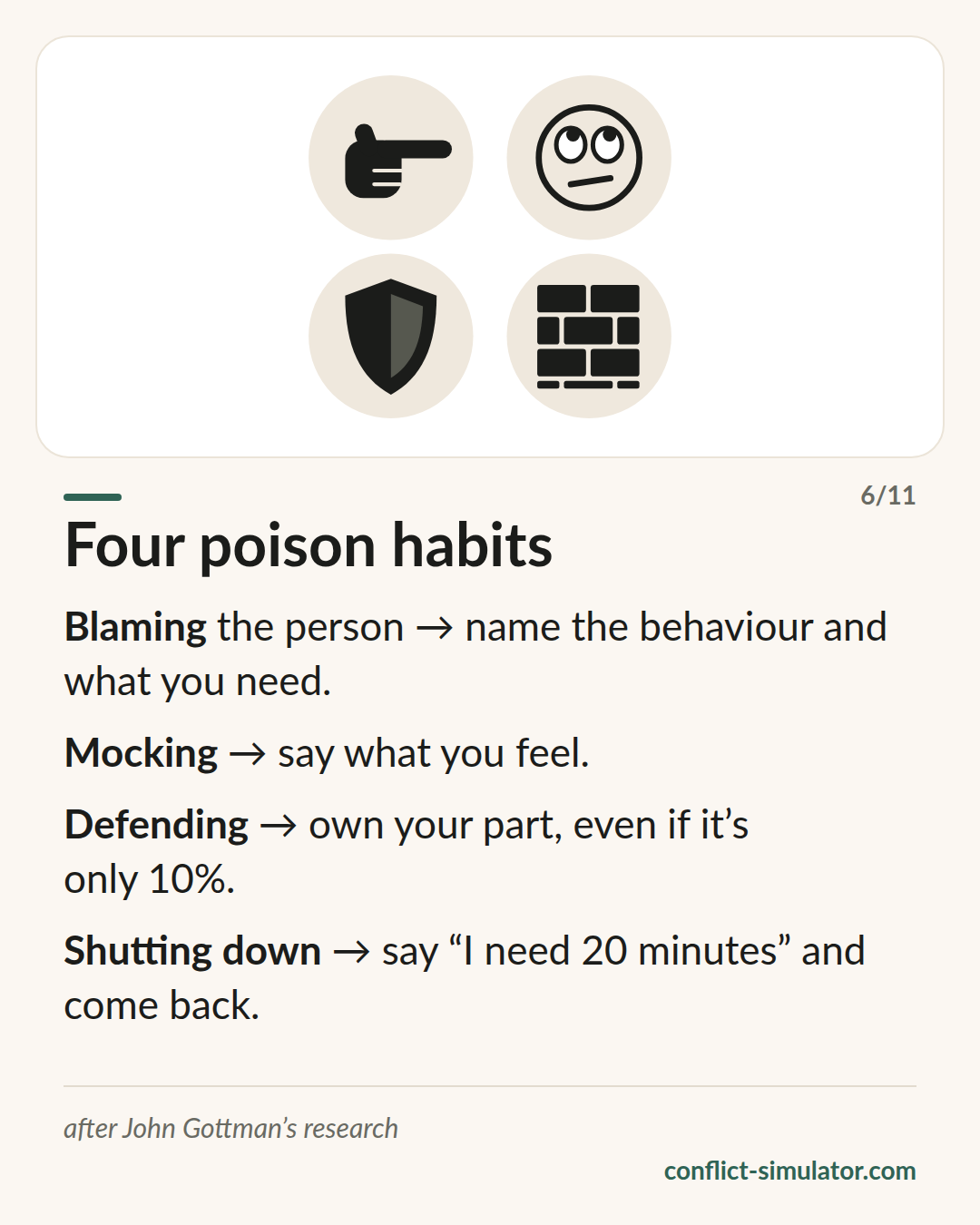
Criticism attacks the person instead of the behaviour (“you are so selfish”). Contempt puts yourself above the other person — mockery, eye-rolling, “yeah, right”. Defensiveness rejects any share of the blame. Stonewalling means shutting down and going silent, usually because you are flooded.
Each has an antidote: name the behaviour and say what you need; say your own feelings instead of mocking; take a part of the responsibility, even if it is only ten percent; call a break and come back. And: how a conversation begins in its first minutes shapes how it ends.
Where it comes from
John Gottman, a psychologist at the University of Washington, with Robert Levenson and later Julie Gottman; books “What Predicts Divorce?” (1994) and “The Seven Principles for Making Marriage Work” (with Nan Silver, 1999). The study on the soft start-up: Carrère and Gottman, Family Process 1999.
The link between contempt, negative affect and poorer relationship outcomes is robust across many labs. What does not hold are the famous numbers: “91 percent prediction accuracy” or “96 percent from the first three minutes” came from small samples without cross-validation and did not survive re-examination (Heyman and Slep 2001). The antidotes themselves have hardly been tested as interventions; they are plausible practice, not a finding.
Evidence: Patterns well supported, prediction rates not, antidotes practice wisdom
What you can do with it before the conversation
Know your horseman
Which of the four is yours when things get tight? Most people have one. Knowing your own lets you spot it a second earlier in the conversation — and a second is often enough.
Detoxify the opening
Strike every “always”, every character word and every barb from your first sentence. What remains is a behaviour, a feeling, a wish. That is the soft start-up.
Keep a repair ready
One sentence to start over with when it tips: “That came out wrong, let me try again.” Repairs work when the other side accepts them — and that is more likely when the sentence was there beforehand.
Where the Konflikt-Simulator uses it
Two of the simulator's rules carry Gottman's name: the rule on contempt markers (“yeah right”, “of course”) runs on all three layers, and in the impact layer a rule catches the harsh start-up with its blame frame. Each shows its origin under the hint.
At the end of the wizard your if-then plan comes with a repair line “If it tips over” — that is Gottman's repair attempt. The card “Four poison habits” puts patterns and antidotes side by side.
Limits
The research comes from couples in a lab. For work and school the transfer is plausible for criticism, contempt and defensiveness, but untested. A conversation with all four horsemen neatly avoided can still fail, and one with a barb in it can succeed. And whoever quotes the numbers — “93 percent”, “in three minutes” — is spreading a myth.