Eleven cards
One idea per card, sixty words at most, one drawing. To download, to print, to pass on.
The cards are licensed CC BY 4.0: print, show, hand out, adapt — with the credit “conflict-simulator.com”. Use in class is expressly welcome. CC BY 4.0 · Imprint
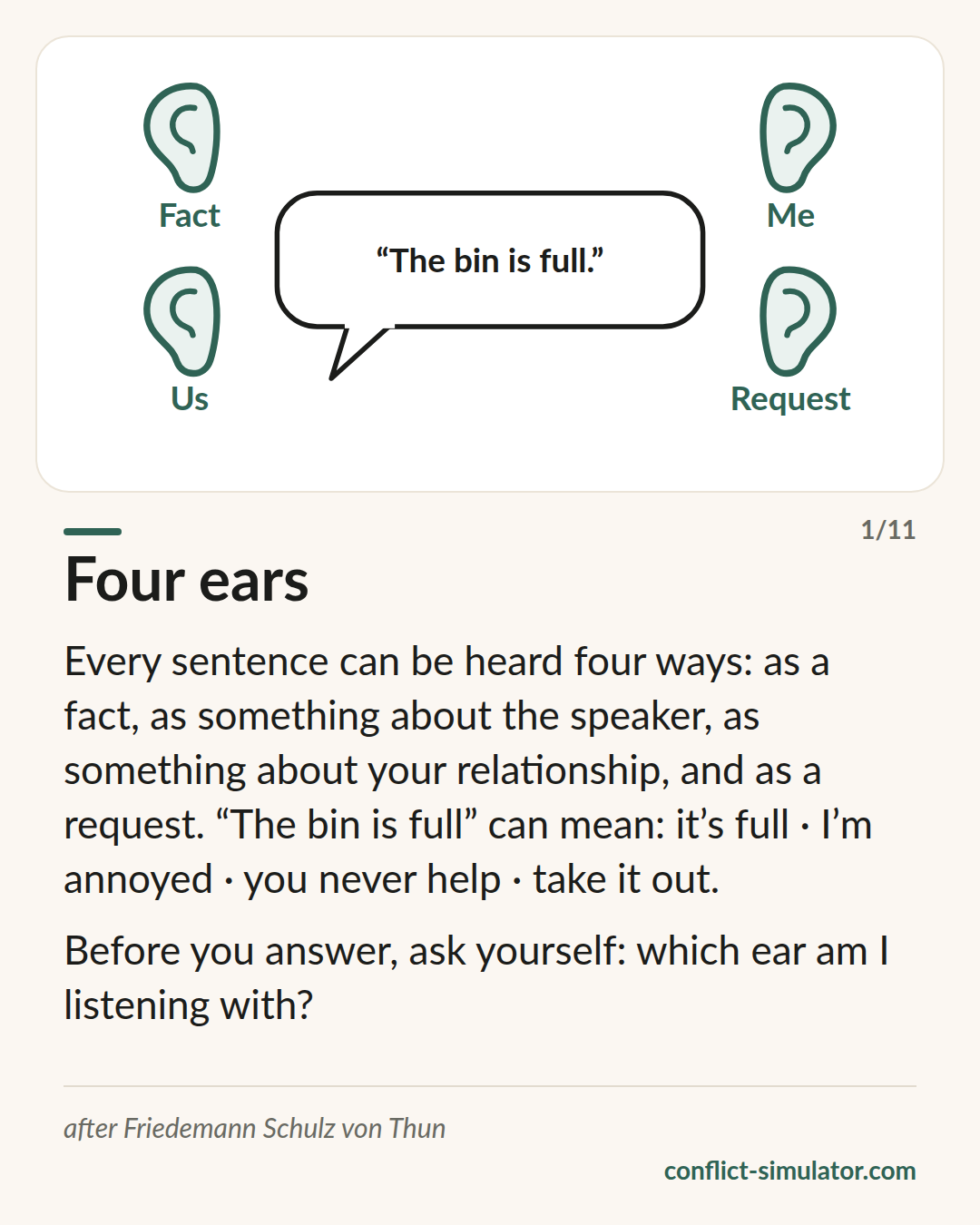
Four ears
Every sentence can be heard four ways: as a fact, as something about the speaker, as something about your relationship, and as a request. “The bin is full” can mean: it’s full · I’m annoyed · you never help · take it out.
Before you answer, ask yourself: which ear am I listening with?
Model: after Friedemann Schulz von Thun
Card: Konflikt-Simulator (Günter Weber), own drawing and own text
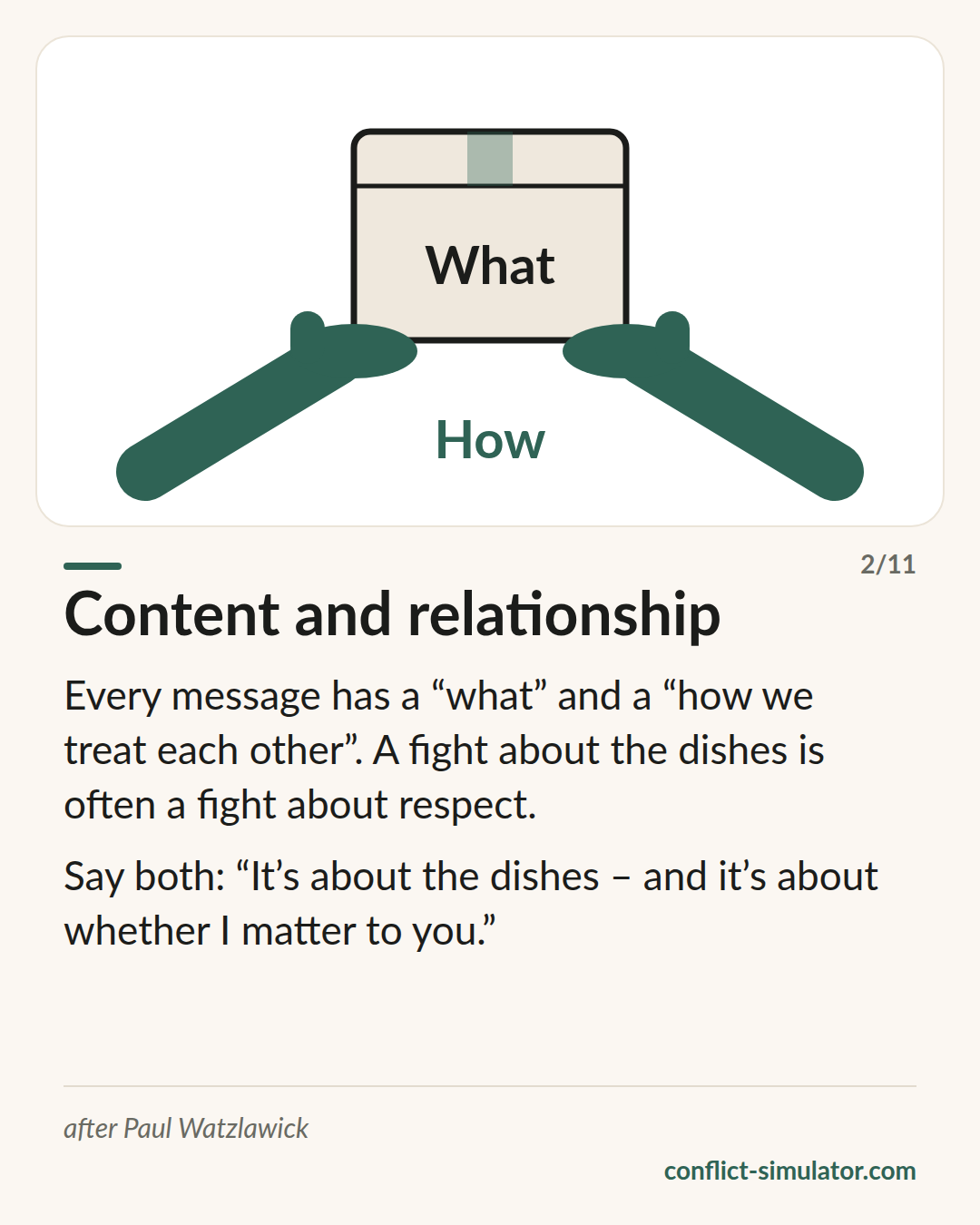
Content and relationship
Every message has a “what” and a “how we treat each other”. A fight about the dishes is often a fight about respect.
Say both: “It’s about the dishes – and it’s about whether I matter to you.”
Model: after Paul Watzlawick
Card: Konflikt-Simulator (Günter Weber), own drawing and own text
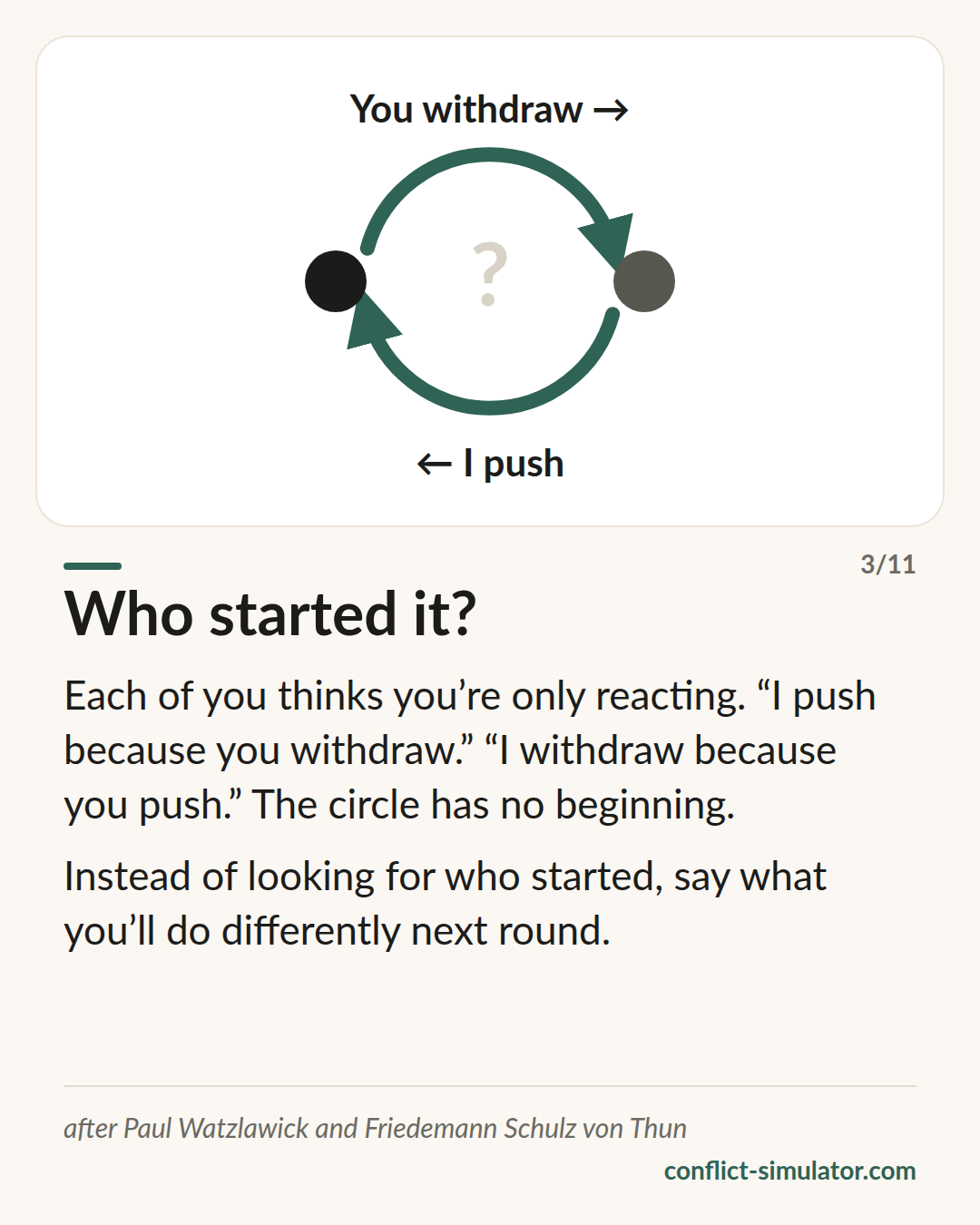
Who started it?
Each of you thinks you’re only reacting. “I push because you withdraw.” “I withdraw because you push.” The circle has no beginning.
Instead of looking for who started, say what you’ll do differently next round.
Model: after Paul Watzlawick and Friedemann Schulz von Thun
Card: Konflikt-Simulator (Günter Weber), own drawing and own text
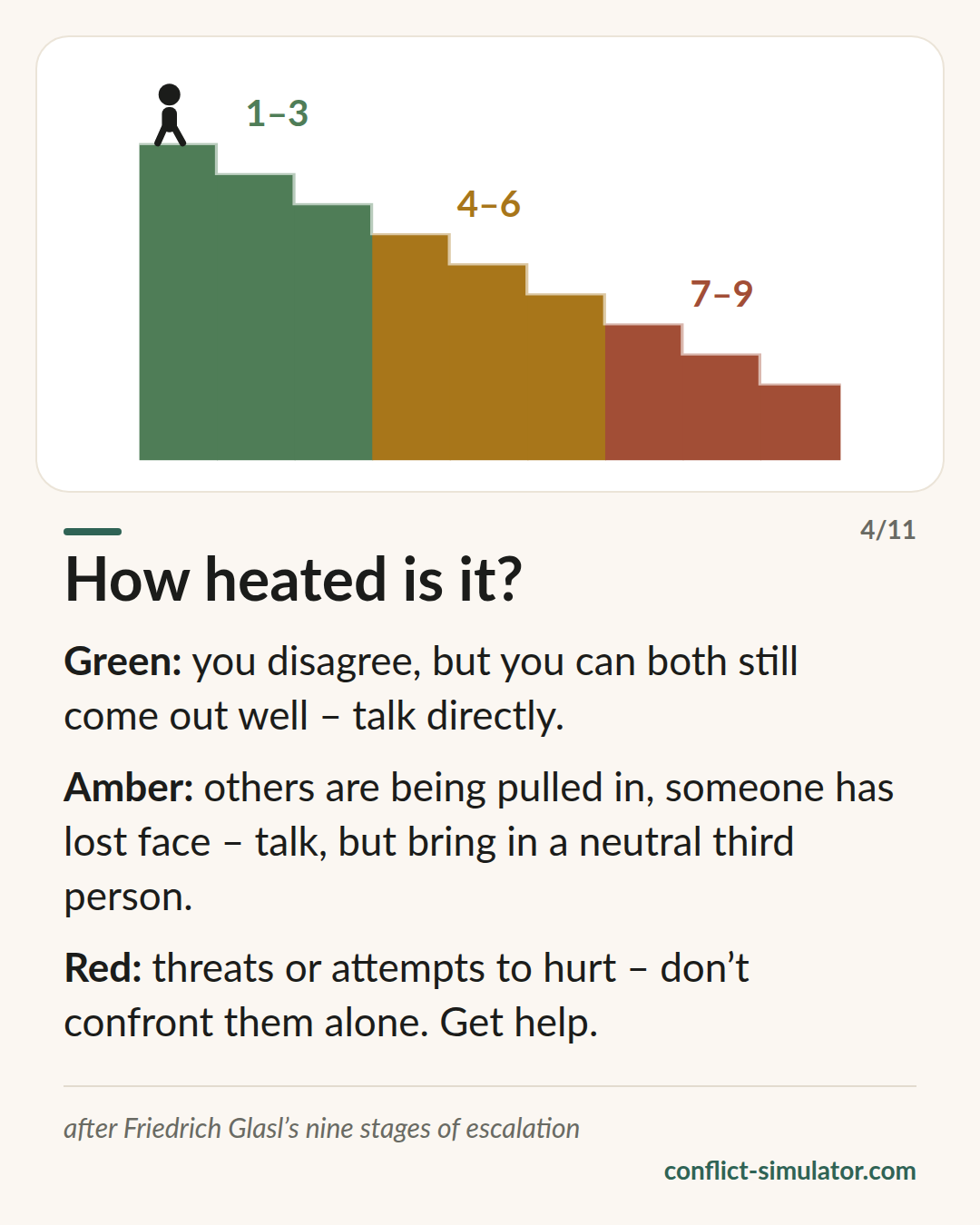
How heated is it?
Green: you disagree, but you can both still come out well – talk directly.
Amber: others are being pulled in, someone has lost face – talk, but bring in a neutral third person.
Red: threats or attempts to hurt – don’t confront them alone. Get help.
Model: after Friedrich Glasl’s nine stages of escalation
Card: Konflikt-Simulator (Günter Weber), own drawing and own text
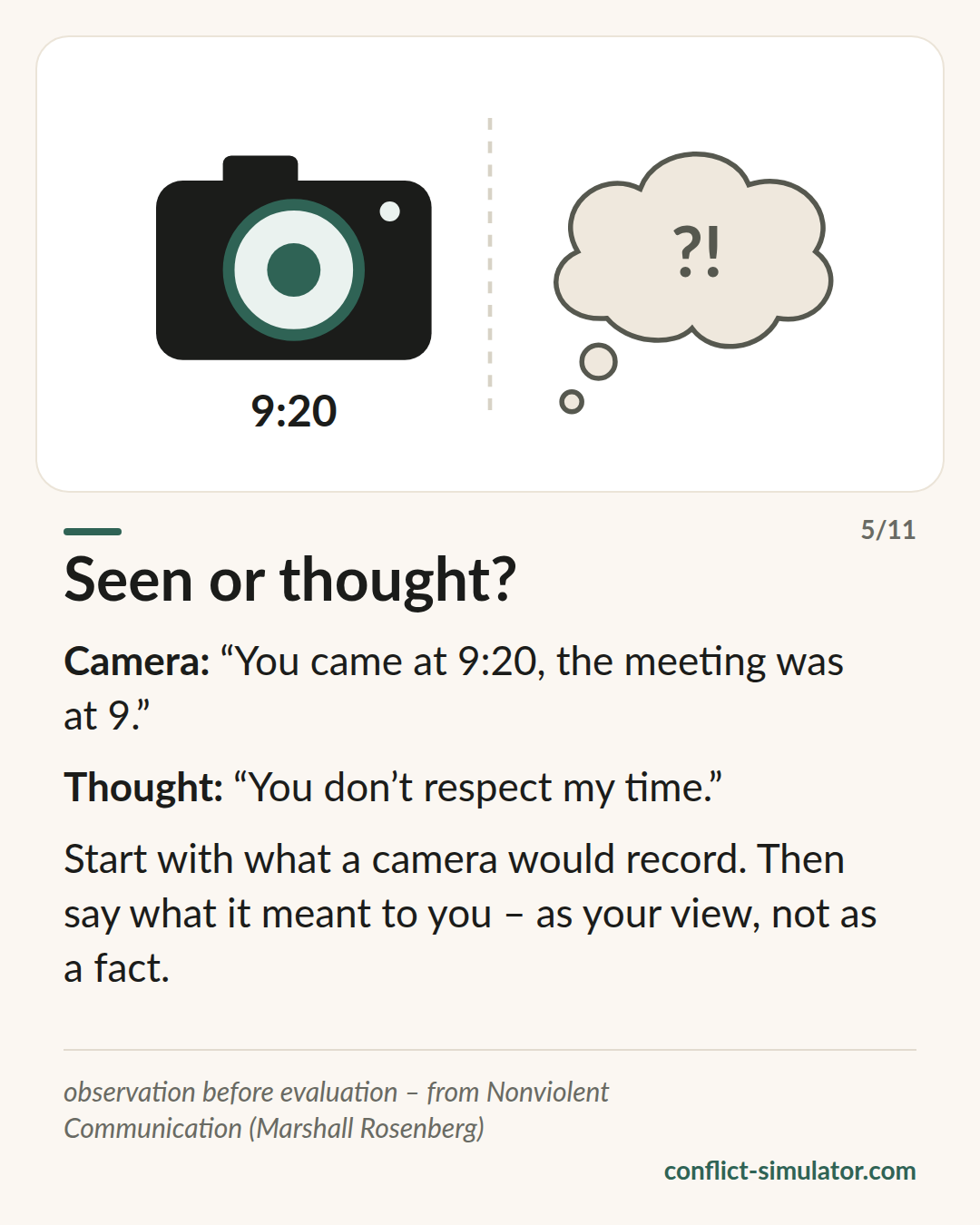
Seen or thought?
Camera: “You came at 9:20, the meeting was at 9.”
Thought: “You don’t respect my time.”
Start with what a camera would record. Then say what it meant to you – as your view, not as a fact.
Model: observation before evaluation – from Nonviolent Communication (Marshall Rosenberg)
Card: Konflikt-Simulator (Günter Weber), own drawing and own text
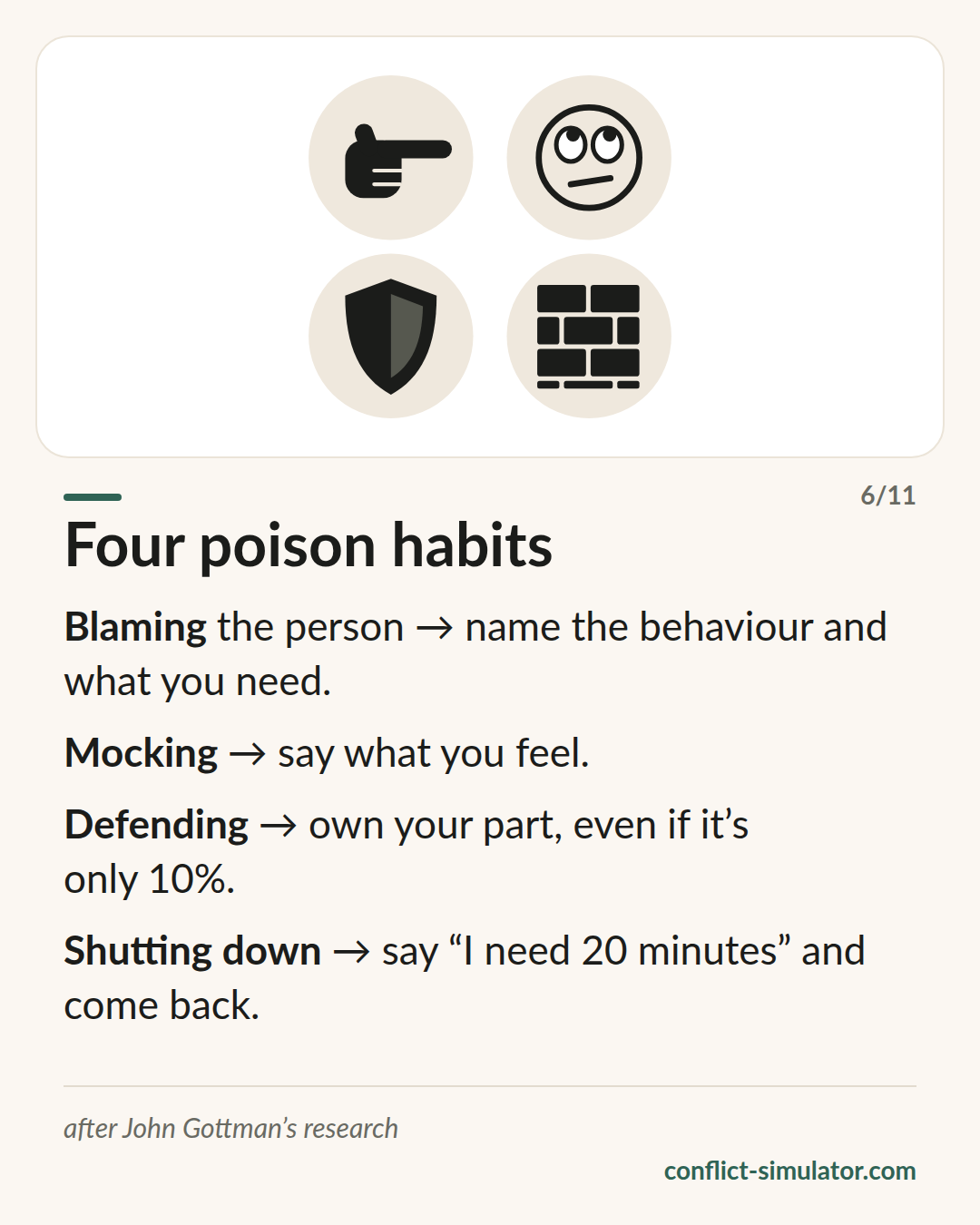
Four poison habits
Blaming the person → name the behaviour and what you need.
Mocking → say what you feel.
Defending → own your part, even if it’s only 10%.
Shutting down → say “I need 20 minutes” and come back.
Model: after John Gottman’s research
Card: Konflikt-Simulator (Günter Weber), own drawing and own text
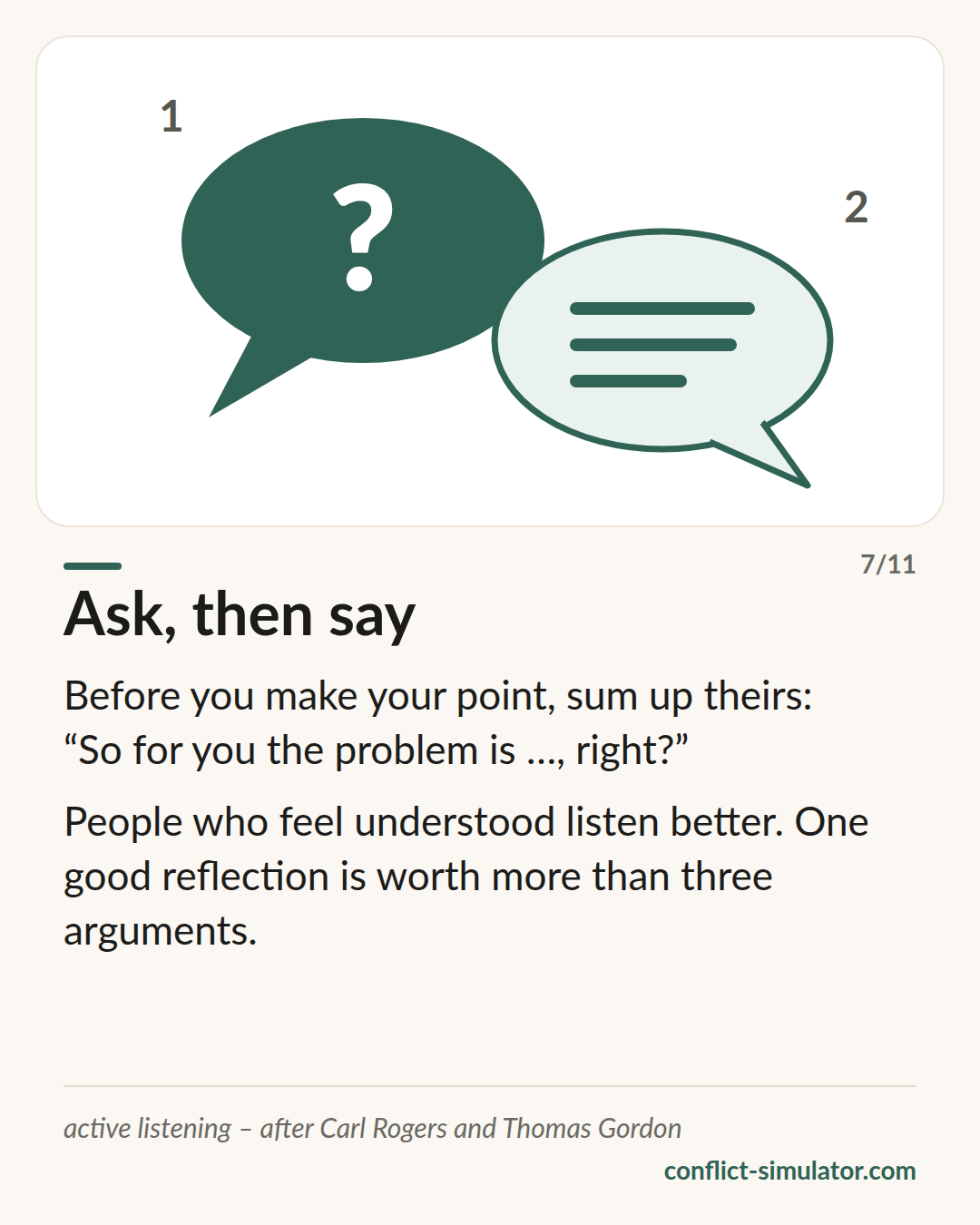
Ask, then say
Before you make your point, sum up theirs: “So for you the problem is …, right?”
People who feel understood listen better. One good reflection is worth more than three arguments.
Model: active listening – after Carl Rogers and Thomas Gordon
Card: Konflikt-Simulator (Günter Weber), own drawing and own text
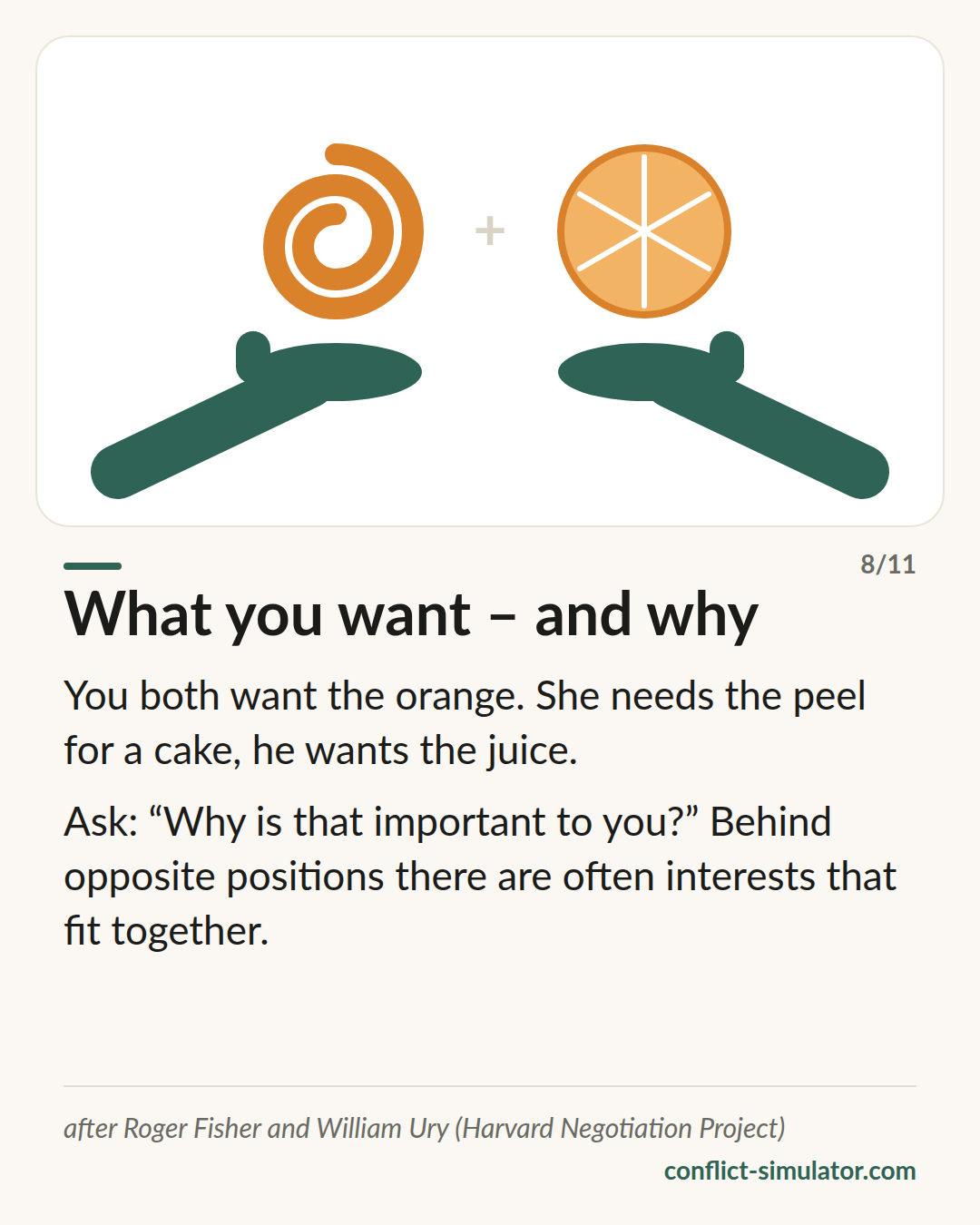
What you want – and why
You both want the orange. She needs the peel for a cake, he wants the juice.
Ask: “Why is that important to you?” Behind opposite positions there are often interests that fit together.
Model: after Roger Fisher and William Ury (Harvard Negotiation Project)
Card: Konflikt-Simulator (Günter Weber), own drawing and own text
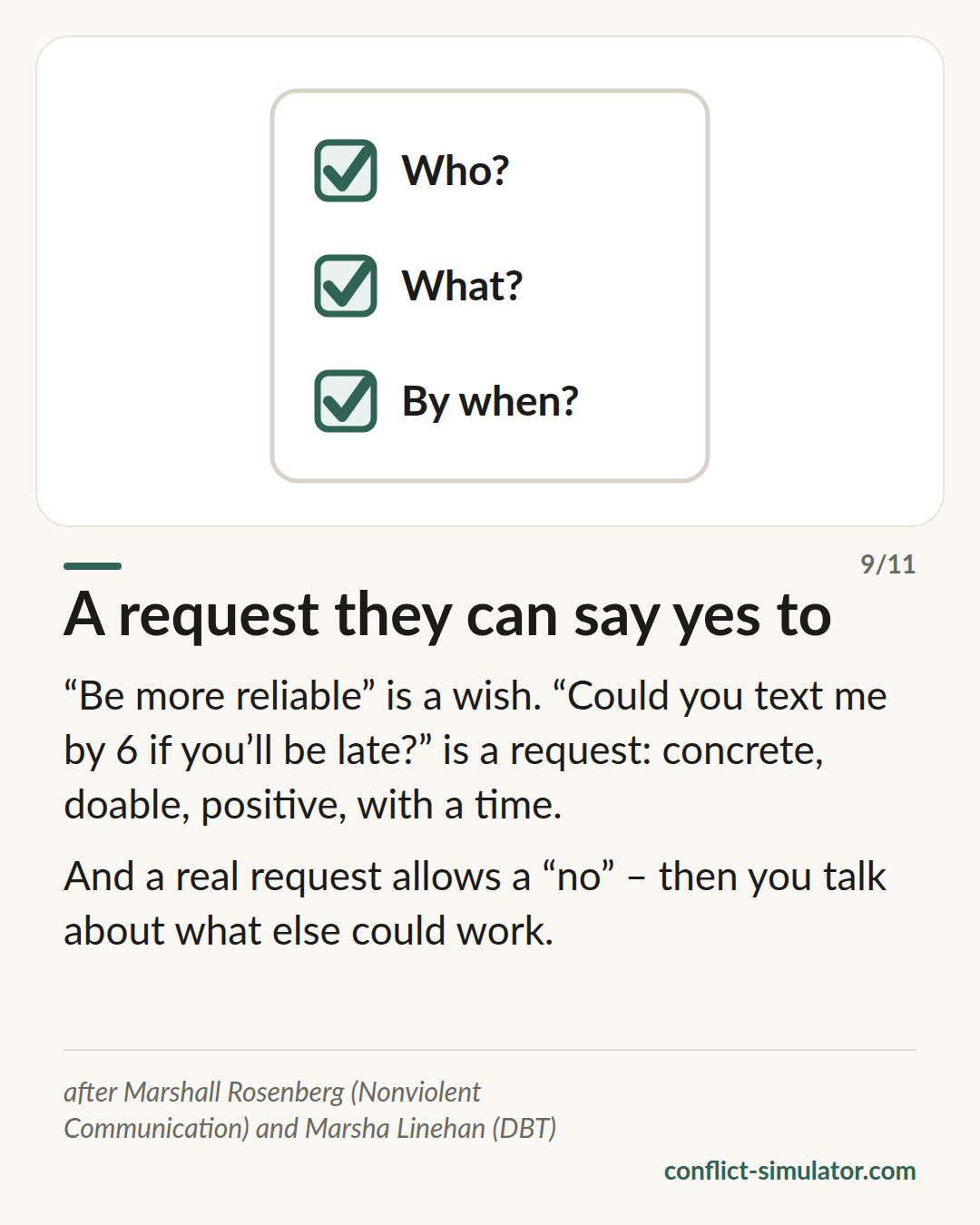
A request they can say yes to
“Be more reliable” is a wish. “Could you text me by 6 if you’ll be late?” is a request: concrete, doable, positive, with a time.
And a real request allows a “no” – then you talk about what else could work.
Model: after Marshall Rosenberg (Nonviolent Communication) and Marsha Linehan (DBT)
Card: Konflikt-Simulator (Günter Weber), own drawing and own text
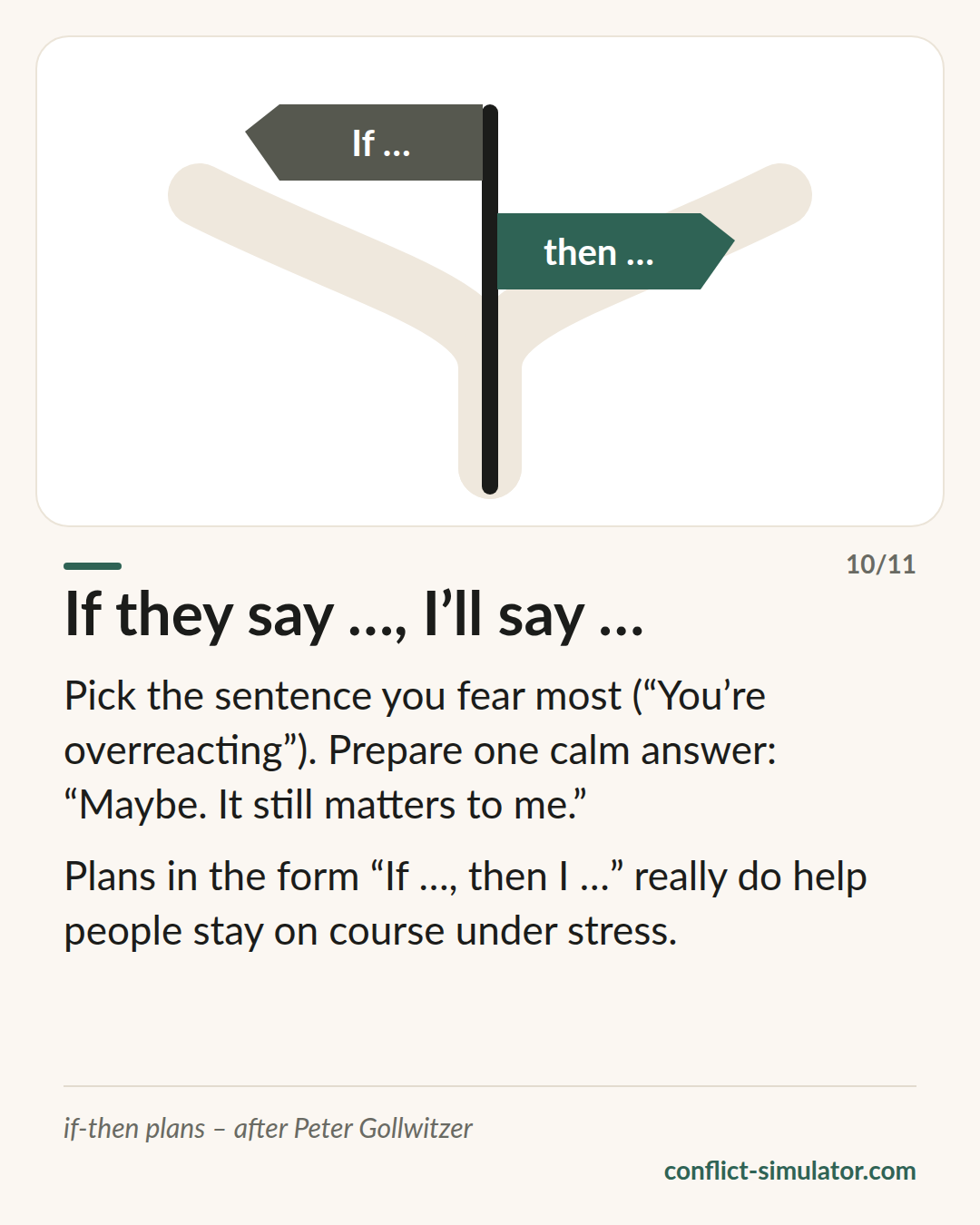
If they say …, I’ll say …
Pick the sentence you fear most (“You’re overreacting”). Prepare one calm answer: “Maybe. It still matters to me.”
Plans in the form “If …, then I …” really do help people stay on course under stress.
Model: if-then plans – after Peter Gollwitzer
Card: Konflikt-Simulator (Günter Weber), own drawing and own text
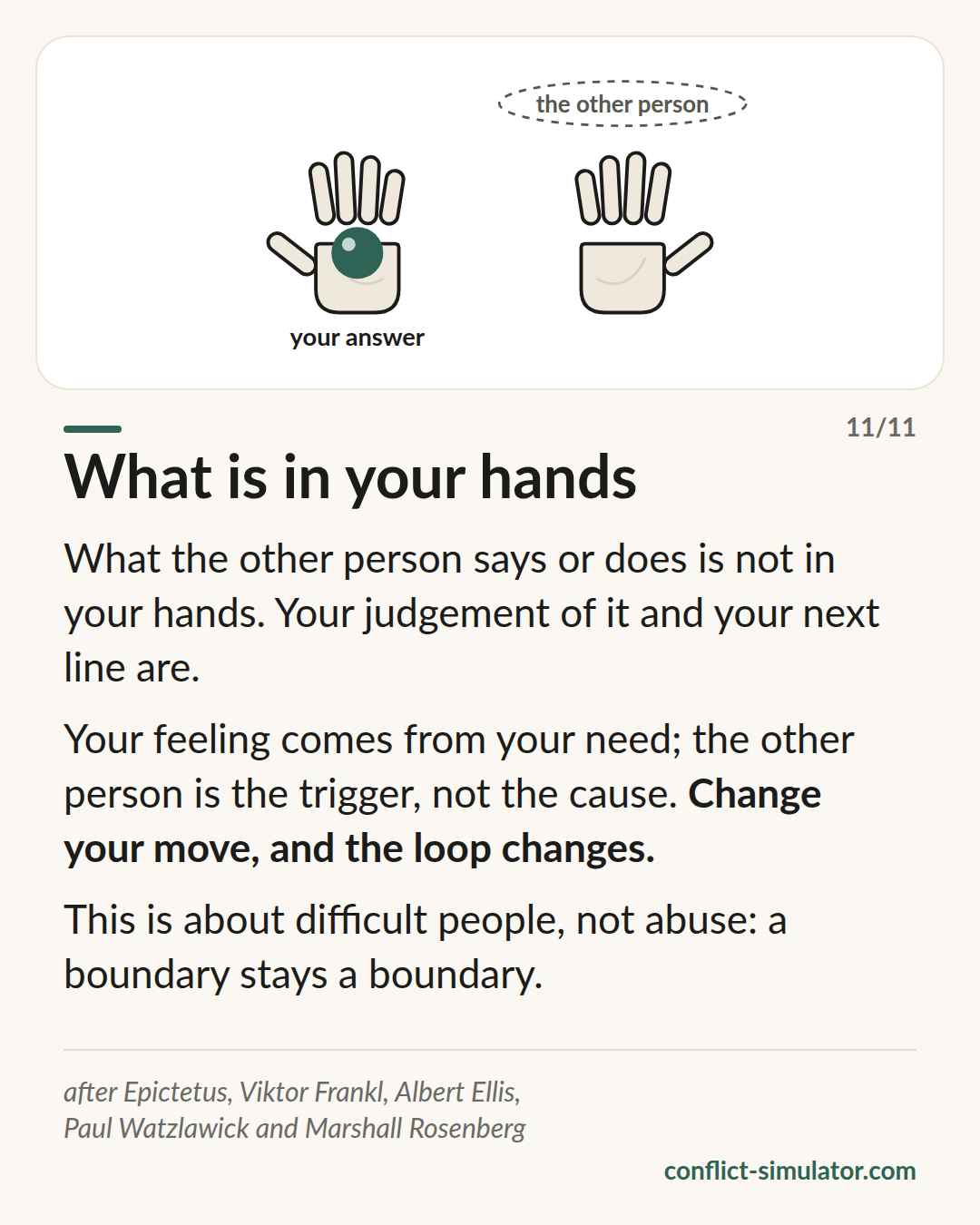
What is in your hands
What the other person says or does is not in your hands. Your judgement of it and your next line are.
Your feeling comes from your need; the other person is the trigger, not the cause. Change your move, and the loop changes.
This is about difficult people, not abuse: a boundary stays a boundary.
Model: after Epictetus, Viktor Frankl, Albert Ellis, Paul Watzlawick and Marshall Rosenberg
Card: Konflikt-Simulator (Günter Weber), own drawing and own text