If-then plans
One prepared sentence for the moment you fear most — the best-supported tool on this site.
What the model says
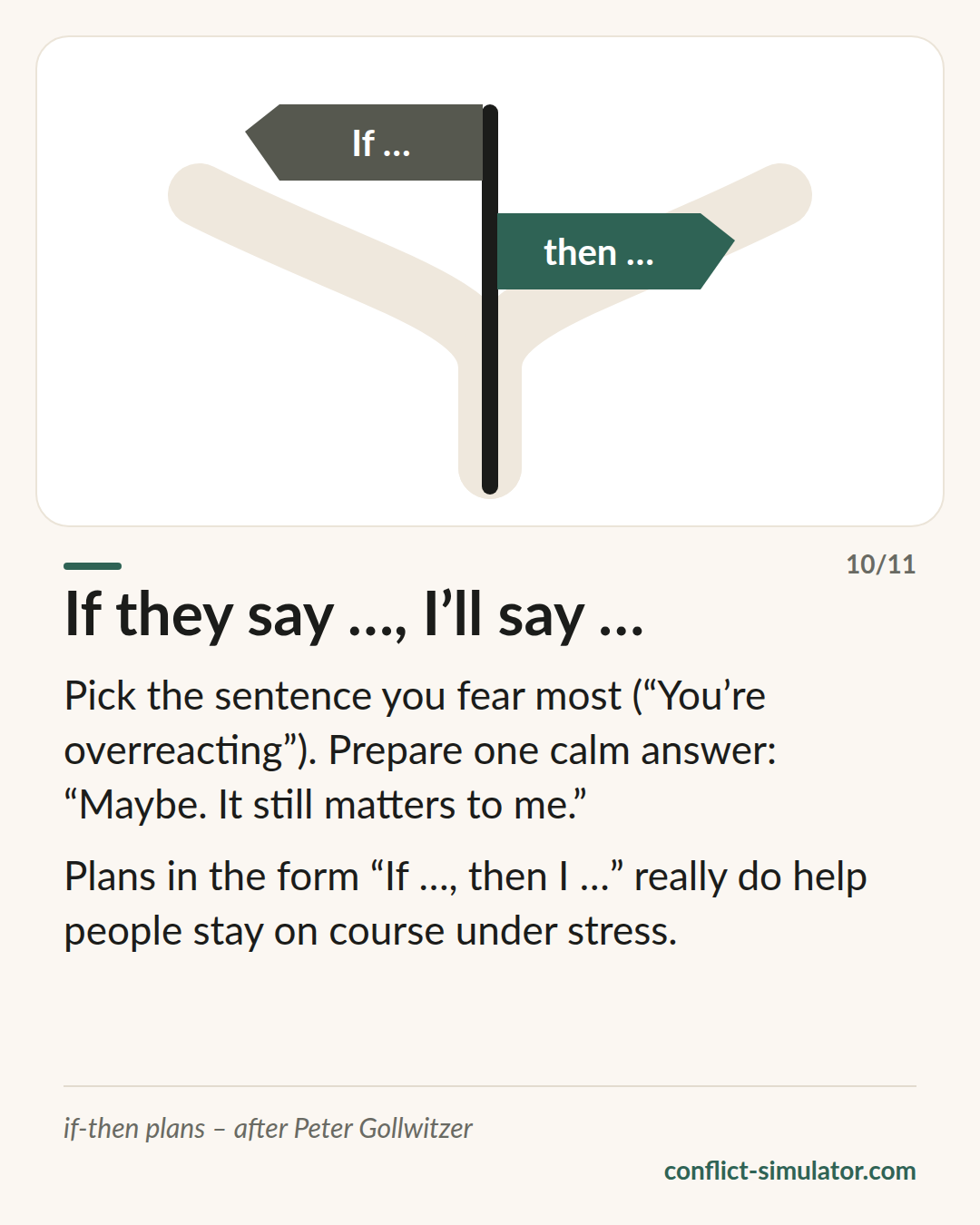
Having a goal (“I will stay calm”) helps little when the moment comes. A plan of the form “If X happens, then I do Y” helps a lot more. Peter Gollwitzer calls this an implementation intention; most people say if-then plan.
The mechanism: the if-condition becomes a cue you recognise almost automatically in the conversation, and the then-action is already waiting. In the hot second you do not have to decide, only to recall.
For a difficult conversation that means: pick the sentence you dread — “You are overreacting”, “Here we go again” — and prepare one calm answer. “Maybe. It still matters to me.”
Where it comes from
Peter Gollwitzer, a social psychologist (Konstanz, New York), published the concept in 1999 in the American Psychologist: “Implementation intentions: Strong effects of simple plans”. The meta-analysis by Gollwitzer and Sheeran (2006) pools 94 studies and finds a medium to large effect on reaching goals (d ≈ .65).
For a tool in conversation preparation that is unusually well supported: randomised experiments, many domains, stable results. Gabriele Oettingen turned it into the four-step exercise “WOOP” (wish, outcome, obstacle, plan), which has been tested too. What is shown is the effect on your own behaviour under pressure — not that the conversation ends well because of it.
Evidence: Well supported — meta-analysis of 94 studies
What you can do with it before the conversation
Pick the sentence you fear
Not ten sentences, one. Which objection do you expect, and which one would most likely throw you? That is your if.
An answer that does not hit back
The then should be short, in the first person and without a counter-attack: “Could be. I still want to talk about it.” Say it out loud twice so it sits in your mouth.
Add a break rule
A second plan in case it tips over: “If I notice I am getting loud, then I say: I need twenty minutes, and I will come back.”
Where the Konflikt-Simulator uses it
At the end of the wizard, “If they say …” asks for exactly this sentence: you pick from typical pushback, get a calm answer to go with it, and a line for the case that it tips over anyway. Both go onto the conversation card, the if-then plan also into the copied text.
The card “If they say …, I'll say …” is the short version; in the practice room you can try the line against a counterpart that really does push back.
Limits
A plan does not make a bad sentence good: whoever resolves “If she disagrees, then I tell her she never understands anything” will reliably do so. The plan works on your behaviour, not on the other person's — and it does not carry once the conversation has reached threats. Too many plans make you stiff; one is enough.